EU–India Relations Enter a Crucial Phase
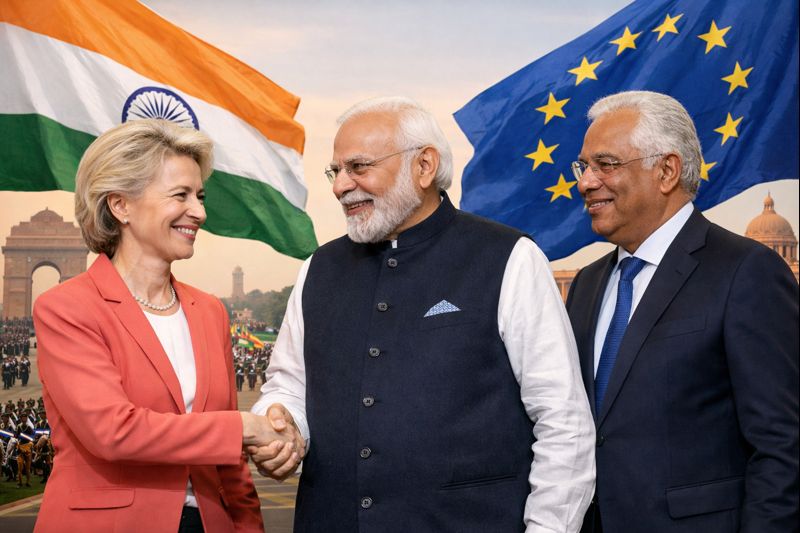
India and the European Union are moving closer to finalising a historic free trade agreement often described as the “mother of all deals.” The proposed pact is expected to strengthen economic, strategic, and geopolitical ties between the two major global powers.
European Commission President Ursula von der Leyen and European Council President Antonio Costa are scheduled to attend India’s Republic Day celebrations before holding a high-level EU–India summit in New Delhi. Leaders on both sides hope the meeting will mark a breakthrough in long-running negotiations.
Trade Talks Near the Finish Line
Negotiations on the EU–India Free Trade Agreement (FTA) began nearly two decades ago and are now close to completion. Speaking recently, von der Leyen said both sides are on the verge of reaching a historic trade agreement that could reshape bilateral relations.
India’s Commerce Minister Piyush Goyal has called the proposed pact the largest and most ambitious trade deal India has ever pursued. For both New Delhi and Brussels, the agreement offers a way to expand markets amid global uncertainty, including US trade tariffs and Chinese export restrictions.
More Than Just an Economic Deal
EU officials stress that the partnership goes beyond trade. According to the EU’s foreign policy chief Kaja Kallas, closer ties with India come at a time when the rules-based international order faces growing pressure from conflicts, coercive diplomacy, and economic fragmentation.
Experts say recent global events have added urgency to the talks. The war in Ukraine and shifting US trade policies have encouraged both India and Europe to diversify alliances and reduce over-dependence on traditional partners.
Untapped Trade Potential
Together, India and the EU represent nearly 25% of global population and GDP. Bilateral trade in goods reached €120 billion in 2024, with trade in services adding another €60 billion, according to EU data.
Despite this growth, India currently accounts for only about 2.5% of total EU goods trade, compared with nearly 15% for China. Officials say this gap highlights the huge untapped potential the free trade agreement could unlock.
Key Sectors and Market Access
European industries such as automobiles, machinery, chemicals, wines, and spirits stand to gain if India lowers its high import tariffs. Analysts note that India remains one of the most protected major economies, with steep duties on products where European firms are globally competitive.
On the other hand, India is seeking easier access to European markets for textiles, pharmaceuticals, and manufactured goods. Strengthening intellectual property protection is also part of the discussions.
Sensitive Issues and Remaining Challenges
Some areas remain difficult. Agriculture is expected to play a limited role, as India aims to protect its dairy and grain sectors, while European farmers remain cautious about market liberalisation.
Other unresolved issues include:
-
The impact of the EU’s carbon border tax on Indian steel exports
-
Safety and quality standards in pharmaceuticals and automobiles
Despite these challenges, EU officials say talks are progressing well and could be wrapped up in time for the summit.
Mobility, Security, and Defence Cooperation
Beyond trade, the agenda includes a mobility agreement to ease movement for students, researchers, seasonal workers, and skilled professionals.
A proposed security and defence partnership would expand cooperation in maritime security, cybersecurity, and counter-terrorism. EU officials say such a pact could pave the way for joint defence manufacturing in the future.
Strategic Shift Away From Dependence
India has long relied on Russia for military equipment but is now working to diversify suppliers and boost domestic defence production. Europe, meanwhile, is also seeking greater strategic autonomy and reducing reliance on the United States.
A New Chapter in EU–India Ties
Officials on both sides describe the moment as transformative. If concluded, the agreement would signal a new era in EU–India relations, combining economic growth, strategic cooperation, and shared global interests.
As one EU official put it, the partnership has the potential to be truly transformative for both regions in an increasingly complex world.