Diabetes Poses a Massive Global Economic Challenge
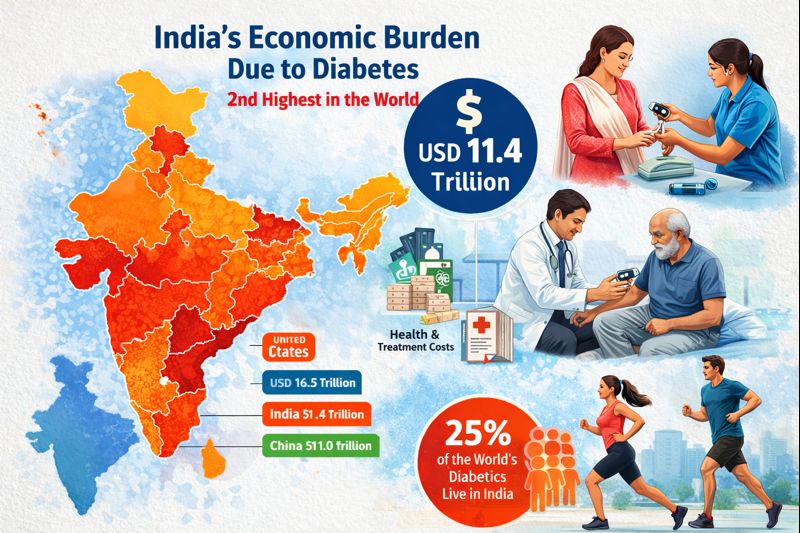
India faces the second largest economic burden from diabetes, estimated at USD 11.4 trillion, just after the United States (USD 16.5 trillion) and ahead of China (USD 11 trillion), according to a new international study. Researchers emphasized that early detection, timely diagnosis, and proper treatment are crucial to reduce both health and financial consequences.
The study, conducted by experts from the International Institute for Applied Systems Analysis and the Vienna University of Economics and Business, analyzed the economic impact of diabetes across 204 countries from 2020 to 2050.
Global Economic Impact of Diabetes
The findings, published in Nature Medicine, reveal that the direct global costs of diabetes total around USD 10 trillion, excluding informal care provided by family members. When informal caregiving is considered, the economic impact rises dramatically to USD 152 trillion, equivalent to 1.7% of the world’s annual GDP.
Professor Klaus Prettner, a co-author from Vienna University, noted, “Caregivers often leave the labor market partially, which adds significant economic costs.” Informal care accounts for nearly 90% of the total economic burden, largely because diabetes prevalence far exceeds mortality rates by 30 to 50 times.
Country-wise Economic Burden
The study highlights that the United States faces the largest economic burden of diabetes at INT$ 2.5 trillion, followed by India at INT$ 1.6 trillion and China at INT$ 1.0 trillion. Including informal care losses, the burden rises sharply:
-
United States: INT$ 16.5 trillion
-
India: INT$ 11.4 trillion
-
China: INT$ 11.0 trillion
For India and China, the high costs are primarily due to large populations affected, while in the US, expenses are driven by high treatment costs and diversion of physical capital.
The study also points out a key difference between high- and low-income countries. In high-income countries, treatment costs constitute 41% of the total economic burden, whereas in low-income countries, they account for only 14%, highlighting disparities in access to medical care for chronic diseases.
Diabetes vs. Other Diseases
The researchers stressed that the economic impact of diabetes exceeds that of Alzheimer’s disease or cancer, making it a critical public health concern worldwide.
Promoting healthy lifestyles, including regular physical activity and a balanced diet, is the most effective strategy to prevent diabetes and reduce economic strain. Additionally, comprehensive screening programs, early diagnosis, and timely treatment are essential for mitigating both health and financial consequences.
India’s Diabetes Burden
Over 25% of the world’s diabetics live in India, according to a 2024 study published in The Lancet. With such a high prevalence, addressing diabetes through public health initiatives, awareness campaigns, and healthcare infrastructure is crucial for India to manage its economic and social burden.